Protein has escaped the gym.
What was once a particular focus of athletes and fitness culture has become mainstream. In the 2025 International Food Information Council Food & Health Survey, “good source of protein” was the most commonly selected characteristic Americans associated with a healthy food, and 70% said they were trying to consume protein.
Protein, in other words, has acquired a health halo—and now we’re seeing that halo applied to foods we don’t usually think of as protein sources.
Including fruits and vegetables.
By the end of this article, you’ll have a simple way to tell whether a protein claim is interesting—or whether a food provides enough protein to actually matter.
Even Fruits and Vegetables Are Getting the “High-Protein” Treatment
The headlines are eye-catching:
Many of these articles provide important context beyond the headline, explaining that the featured fruits contain more protein than most other fruits, or reminding readers that fruits generally aren’t major protein sources.
More protein than other fruits doesn’t automatically make a fruit a meaningful protein source.
Think of it like a food package: the headline is the front. Sometimes we need to turn it over for the context.
Fruits and Vegetables Don’t Need Protein to Be Healthy
Fruits and vegetables already bring plenty to the table—fiber, vitamins, minerals and a wide range of plant compounds among them.
Protein isn’t what makes them worth eating.
The question isn’t whether a food contains protein. It’s whether it provides a meaningful amount in a realistic portion.
This matters even more for people who don’t eat many traditional protein foods. If fruits and vegetables labeled “high protein” start taking the place of more concentrated protein sources, getting enough protein can become harder—especially without foods such as beans, lentils, soy foods, nuts, seeds, dairy or eggs.
We’ll come back to that in a future article. For now, let’s put these protein claims into perspective.
Putting Protein Content in Perspective
One large egg provides about 6 grams of protein. Six grams isn’t a magic cutoff; we’re using an egg as a familiar yardstick for comparing different foods.
So, let’s ask:
How much of each “high-protein” fruit or vegetable would we actually have to eat to get the same 6 grams of protein?
Same 6 Grams of Protein. Very Different Amounts of Food.
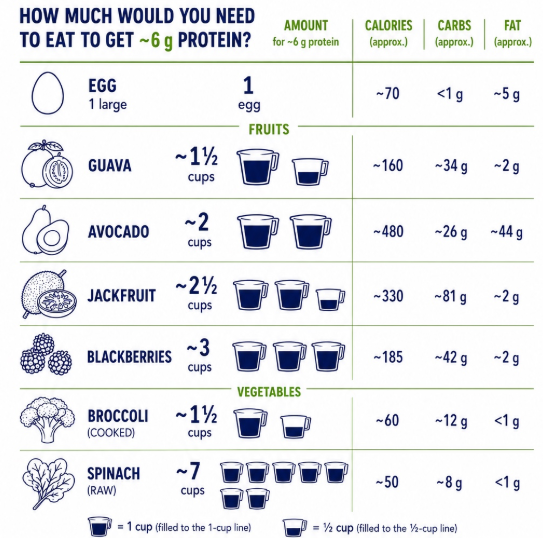
Values are approximate. Variety, preparation and the way a food is cut or packed into a cup can change both volume and nutrient values. These aren’t suggested portions—the comparison is simply meant to make the scale visible.
Guava illustrates the point particularly well: it genuinely contains more protein than most fruits, yet getting the protein in one egg still takes about 1½ cups—roughly several medium guavas.
Seven Cups of Spinach Put an Impressive Percentage in Perspective
Spinach can sound surprisingly protein-rich because protein accounts for a substantial percentage of its calories.
But spinach has very few calories to begin with.
Getting roughly 6 grams of protein from raw spinach takes around seven cups of leaves.
So a food can have an impressive percentage of calories from protein while providing relatively few grams in the amount we’d ordinarily eat.
Edamame and Lentils Are a Different Protein Story
Some “high-protein vegetable” lists put edamame, lentils, beans and chickpeas alongside broccoli, asparagus and spinach.
But nutritionally, they’re quite different.
Edamame is a soybean. Lentils and chickpeas are legumes. These foods can provide meaningful amounts of plant protein in ordinary portions.
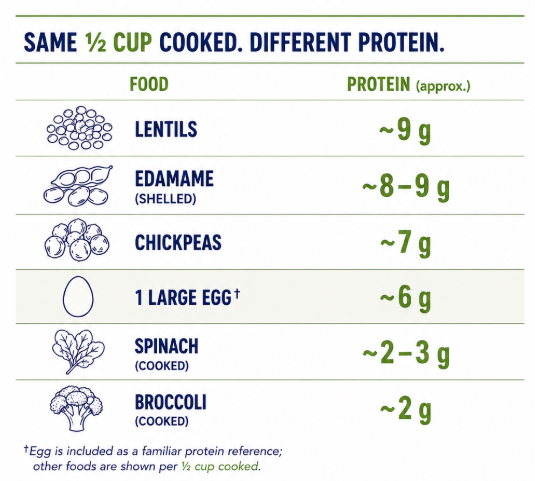
Edamame and lentils can realistically help provide the protein in a meal. Broccoli and spinach generally can’t.
What’s Worth Remembering
When you’re counting on a food for protein, ask:
Does it provide a meaningful amount of protein in a portion I’d realistically eat?
Eat fruits and vegetables for what they do well. Get significant protein from foods that provide significant protein.
And then there’s jackfruit.
Jackfruit Can Replace Meat in a Recipe Without Replacing Its Protein
Young jackfruit deserves special attention because it isn’t always eaten simply as fruit. In some recipes, it’s used to replace meat.
In tacos, curries and barbecue sandwiches, its fibrous texture can resemble shredded chicken or pulled pork, while its mild flavor takes on the seasonings and sauces around it.
But compare the protein on an equal-weight basis:
| Food | Amount | Approx. protein |
|---|---|---|
| Young jackfruit | 3 oz (85 g) | ~1–2 g |
| Cooked hamburger patty | 3 oz (85 g) | ~22 g |
| Cooked chicken breast | 3 oz (85 g) | ~26 g |
Replacing a food in a recipe isn’t necessarily the same as replacing what that food contributed nutritionally.
And that leads to our next question: